Joseph Clark Collection
Béla Kádár
1877–1956 · Painting and works on paper
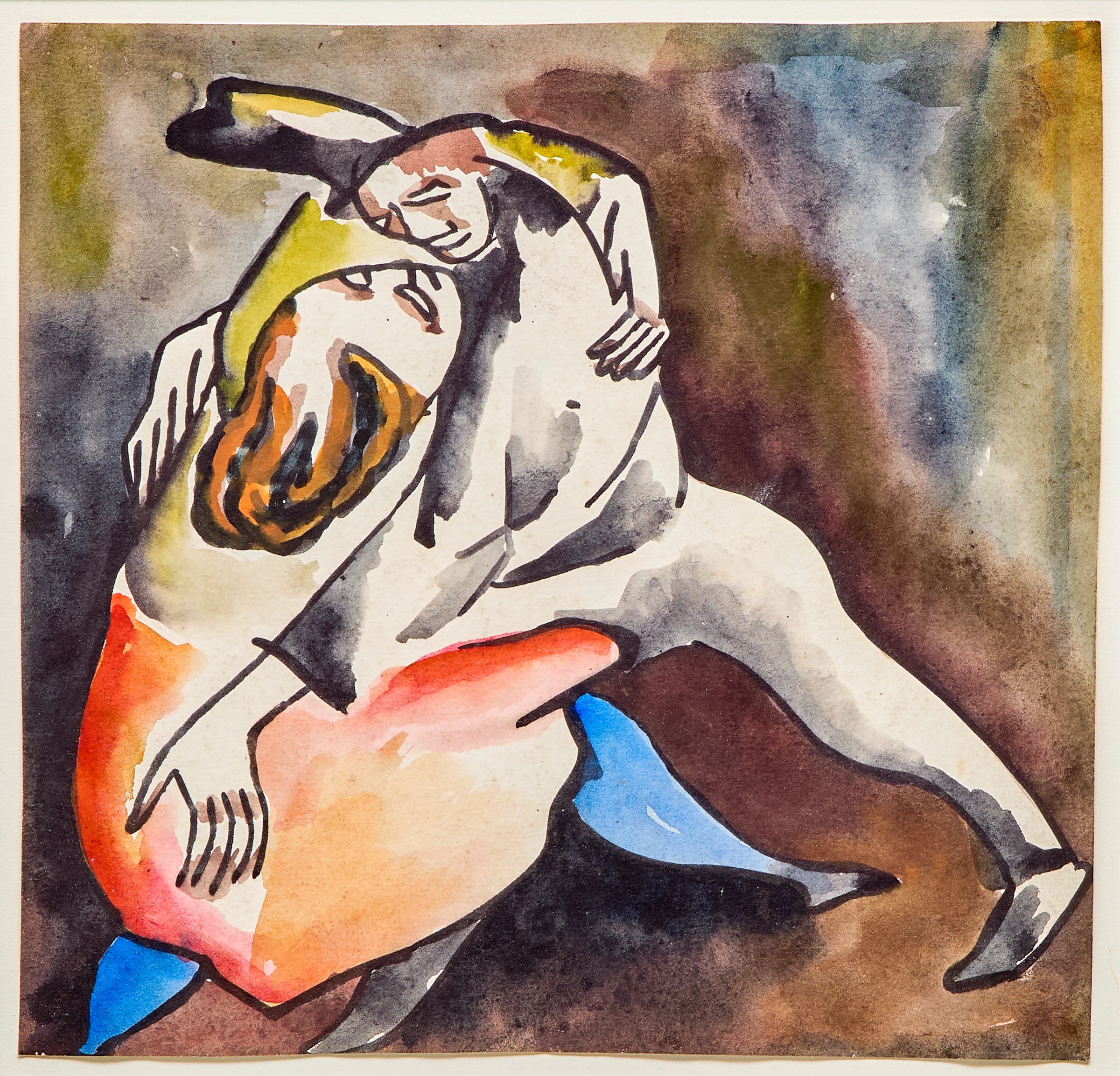
Béla Kádár (1877–1956) was a Hungarian modernist painter from Budapest whose work drew on Cubism, Constructivism, German Expressionism and Hungarian folk imagery. He showed at Herwarth Walden's Galerie Der Sturm in Berlin in 1923, and the Hungarian National Gallery holds many of his works.
In the collection
About the artist
Béla Kádár was born Béla Klug in Budapest on 14 June 1877 and died there on 22 January 1956 (Hungarian Wikipedia). He came from a working-class Jewish family, was apprenticed as an iron-turner after only six years of schooling, and began by painting murals in Budapest (Wikipedia). From 1899 he studied at the Budapest school of industrial drawing and, from 1902, under Ede Balló, and in 1921 he exhibited his expressionist work in Vienna with Hugo Scheiber (Hungarian Wikipedia).
His first important exhibition opened in October 1923 at Herwarth Walden's Galerie Der Sturm in Berlin. There he met Katherine Dreier, who organised two exhibitions of his work at the Brooklyn Museum in New York; Kádár travelled to the second, in September 1928 (Wikipedia). His scenes of figures, landscapes and interiors combine Constructivism, Cubism and German Expressionism with Hungarian folklore, in bright palettes and fractured space (Rosenberg & Co). The Hungarian National Gallery held a memorial exhibition in 1971 and holds many of his works (Hungarian Wikipedia).
Sources
More from the collection
- Marion Adnams
- Nick Ballón
- Phyllida Barlow
- Georg Baselitz
- Tova Berglund
- Bertil Berntsson
- Sutapa Biswas
- Louise Bourgeois
- Alexander Calder
- Mia Chaplin
- Eduardo Chillida
- Martin Creed
- Siobhán Doran
- Katie Fishlock
- Lucian Freud
- Delphine Gaborit
- Wyatt Gallery
- Naomi Gilon
- Hugo Glendinning
- Anthea Hamilton
- Michael Hill
- Meta Isæus-Berlin
- Twan Janssen
- Anish Kapoor
- Zena Kay
- Teema Keroppi
- Grizelda Kitching
- Ella Kruglyanskaya
- Jac Leirner
- Glenn Ligon
- John Lloyd
- Machine Woman
- Heiko Mager
- Joseph-Laurent Malaine
- Joe Mama-Nitzberg
- Imogen Marsteller
- France-Lise McGurn
- Mary Miss
- Keith Newlove
- Ray Parker
- Victor Pasmore
- Fabian Peake
- Jeffrey Porterfield
- Tamsin Relly
- Craig Robertson
- Lewis Ronald
- Bengt Rosenström
- Pekka Ryynänen
- Hugó Scheiber
- Dana Schutz
- Rachel Scott
- Tai Shani
- James Shaw
- Tim A Shaw
- Yukako Shibata
- Daniel Silver
- Selene States
- Joseph Stevenson
- Antonio Tarsis
- Roberta Vilić
- Zhang Enli