Joseph Clark Collection
Eduardo Chillida
1924–2002 · Sculpture, printmaking and collage
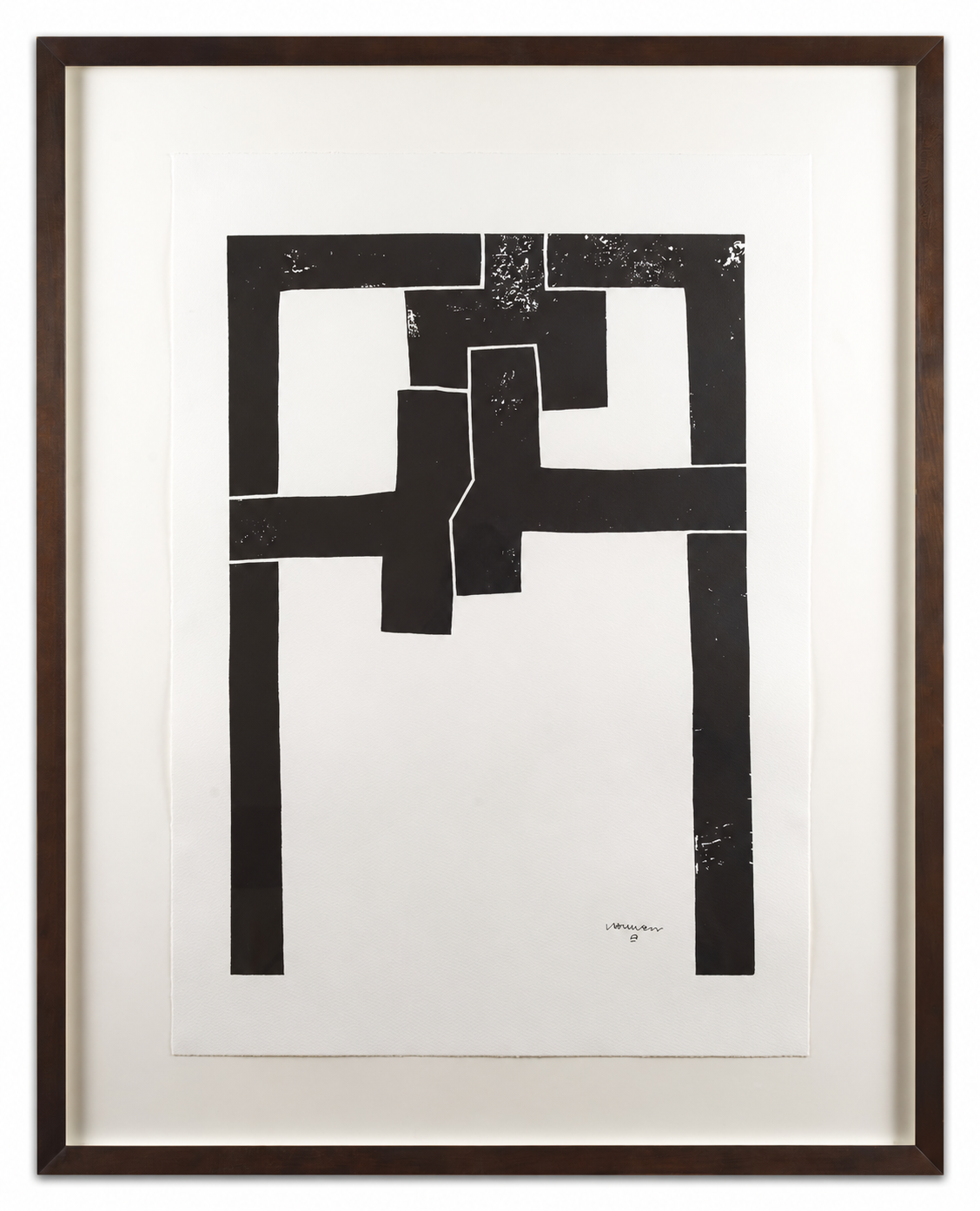
Eduardo Chillida (1924–2002) was a Basque sculptor from San Sebastián who worked in forged iron, steel, wood, alabaster and concrete and also made etchings, lithographs and woodcuts. He received the Carnegie Prize for sculpture in 1964 and the Praemium Imperiale in 1991, and Tate holds his work.
In the collection
About the artist
Eduardo Chillida Juantegui was born in San Sebastián on 10 January 1924. He kept goal for Real Sociedad until a knee injury ended his football career, studied architecture in Madrid from 1943 to 1946, and in 1947 gave it up for art, moving to Paris the following year to work in plaster and clay (Wikipedia). His early work shows the influence of archaic Greek sculpture and Henry Moore; after settling in Hernani he began working in iron and made his first abstract iron sculpture, Illarik (Fundación MAPFRE).
He forged iron with the help of a local blacksmith, used wood in the Anvil of Dreams series from 1954 to 1966, and took up alabaster in 1965. From 1959 he also made etchings, lithographs and woodcuts (Wikipedia). He worked in concrete with the engineer José Antonio Fernández Ordóñez and in ceramic with Joan Artigas (Fundación MAPFRE). His public works include The Comb of the Wind on the rocks of La Concha bay in San Sebastián, De Musica in Dallas and Topos V, shown in Barcelona's Plaça del Rei since 1986 (Wikipedia).
Chillida showed at the Venice Biennale in 1958, 1988 and 1990 and at Documenta II, IV and VI, received the Carnegie Prize for sculpture at the Pittsburgh International in 1964, and had retrospectives at the Solomon R. Guggenheim Museum in 1980 and the Museo Nacional Centro de Arte Reina Sofía in 1999. His honours include the Wolf Prize in Sculpture (1985) and the Praemium Imperiale (1991). He died near San Sebastián on 19 August 2002 (Wikipedia). Tate holds his Modulation of Space I (1963) (Tate), and the Chillida Leku museum in Hernani, created in 2000 and relaunched in 2019, keeps his legacy (Fundación MAPFRE).
Sources
More from the collection
- Marion Adnams
- Nick Ballón
- Phyllida Barlow
- Georg Baselitz
- Tova Berglund
- Bertil Berntsson
- Sutapa Biswas
- Louise Bourgeois
- Alexander Calder
- Mia Chaplin
- Martin Creed
- Siobhán Doran
- Katie Fishlock
- Lucian Freud
- Delphine Gaborit
- Wyatt Gallery
- Naomi Gilon
- Hugo Glendinning
- Anthea Hamilton
- Michael Hill
- Meta Isæus-Berlin
- Twan Janssen
- Béla Kádár
- Anish Kapoor
- Zena Kay
- Teema Keroppi
- Grizelda Kitching
- Ella Kruglyanskaya
- Jac Leirner
- Glenn Ligon
- John Lloyd
- Machine Woman
- Heiko Mager
- Joseph-Laurent Malaine
- Joe Mama-Nitzberg
- Imogen Marsteller
- France-Lise McGurn
- Mary Miss
- Keith Newlove
- Ray Parker
- Victor Pasmore
- Fabian Peake
- Jeffrey Porterfield
- Tamsin Relly
- Craig Robertson
- Lewis Ronald
- Bengt Rosenström
- Pekka Ryynänen
- Hugó Scheiber
- Dana Schutz
- Rachel Scott
- Tai Shani
- James Shaw
- Tim A Shaw
- Yukako Shibata
- Daniel Silver
- Selene States
- Joseph Stevenson
- Antonio Tarsis
- Roberta Vilić
- Zhang Enli