Joseph Clark Collection
Victor Pasmore
1908–1998 · Abstract painting, relief construction and printmaking
Victor Pasmore (1908–1998) was a British artist who moved from figurative painting to abstraction in the late 1940s and led the development of abstract art in Britain in the 1940s and 1950s. He represented Britain at the 1961 Venice Biennale and designed the Apollo Pavilion in Peterlee.
In the collection
About the artist
Victor Pasmore was born in Chelsham, Surrey, on 3 December 1908 (Wikipedia). After his father's death in 1927 he took an administrative job at the London County Council and studied painting part-time at the Central School of Art; he was associated with the formation of the Euston Road School and painted views of the Thames at Hammersmith in a lyrical figurative style (Wikipedia).
From 1947 he worked in a purely abstract style, influenced by Ben Nicholson and the artists around Circle, and made collages and relief constructions, sometimes at architectural scale (Wikipedia). Herbert Read called the change 'the most revolutionary event in post-war British art' (Wikipedia). He taught at King's College, University of Durham, in Newcastle from 1954 to 1961, and in 1955 became consulting director of architectural design for Peterlee new town, where he designed the Apollo Pavilion (Wikipedia).
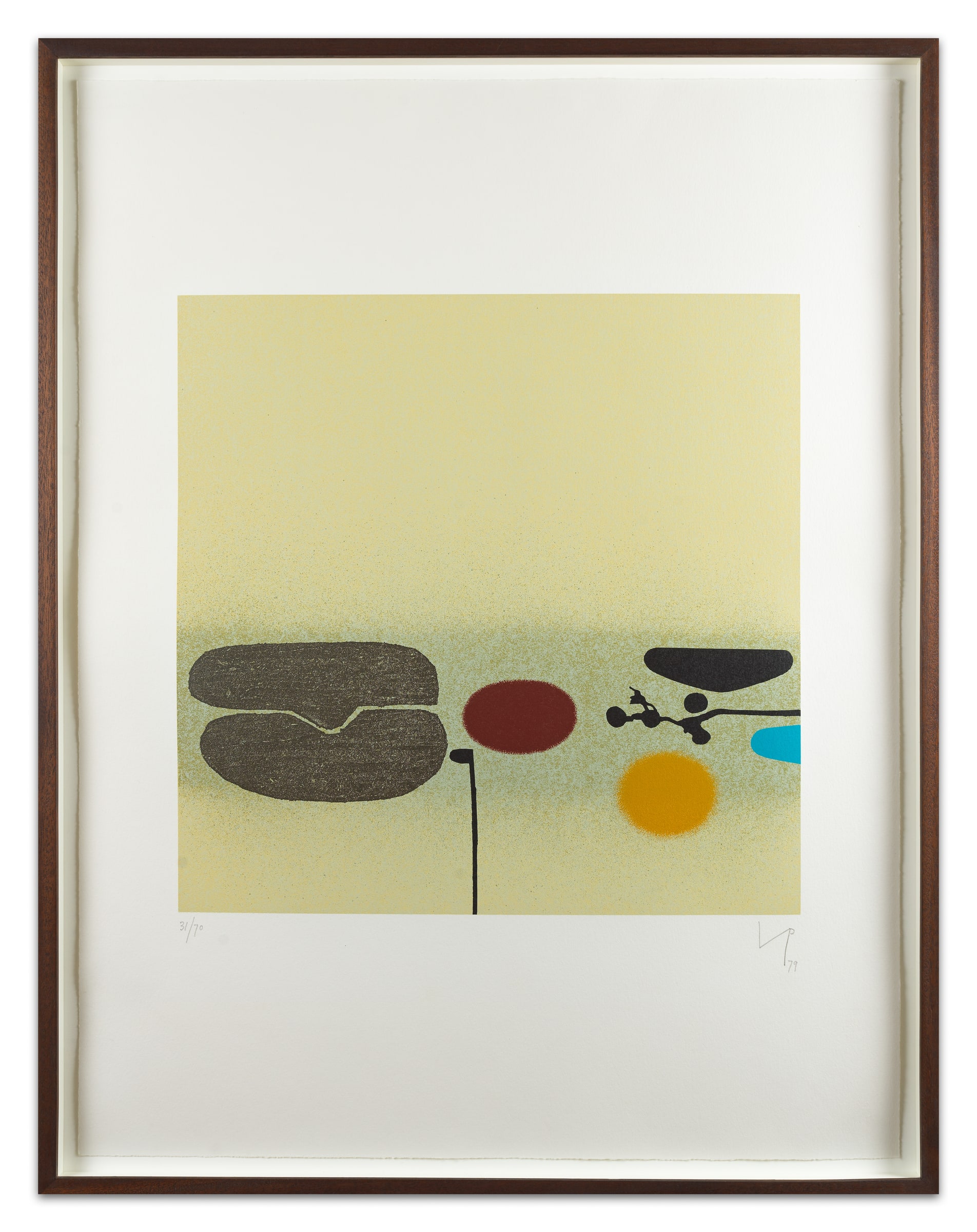
He took part in Documenta II in Kassel in 1959, represented Britain at the 1961 Venice Biennale and served as a trustee of the Tate Gallery (Wikipedia); Tate holds a large group of his works (Tate). He moved to Malta in 1966 and died in Gudja on 23 January 1998 (Wikipedia). The Joseph Clark Collection holds Points of Contact No. 29, a screenprint of 1979 (Joseph Clark Collection).
Sources
More from the collection
- Marion Adnams
- Nick Ballón
- Phyllida Barlow
- Georg Baselitz
- Tova Berglund
- Bertil Berntsson
- Sutapa Biswas
- Louise Bourgeois
- Alexander Calder
- Mia Chaplin
- Eduardo Chillida
- Martin Creed
- Siobhán Doran
- Katie Fishlock
- Lucian Freud
- Delphine Gaborit
- Wyatt Gallery
- Naomi Gilon
- Hugo Glendinning
- Anthea Hamilton
- Michael Hill
- Meta Isæus-Berlin
- Twan Janssen
- Béla Kádár
- Anish Kapoor
- Zena Kay
- Teema Keroppi
- Grizelda Kitching
- Ella Kruglyanskaya
- Jac Leirner
- Glenn Ligon
- John Lloyd
- Machine Woman
- Heiko Mager
- Joseph-Laurent Malaine
- Joe Mama-Nitzberg
- Imogen Marsteller
- France-Lise McGurn
- Mary Miss
- Keith Newlove
- Ray Parker
- Fabian Peake
- Jeffrey Porterfield
- Tamsin Relly
- Craig Robertson
- Lewis Ronald
- Bengt Rosenström
- Pekka Ryynänen
- Hugó Scheiber
- Dana Schutz
- Rachel Scott
- Tai Shani
- James Shaw
- Tim A Shaw
- Yukako Shibata
- Daniel Silver
- Selene States
- Joseph Stevenson
- Antonio Tarsis
- Roberta Vilić
- Zhang Enli